


People who search for a “non-invasive glucose meter” usually want one thing: to track their blood sugar without constant finger pricks. In 2026 that is possible, just not quite in the way the name suggests. Here is what actually exists, which systems are available in Ukraine and how to choose one.
A truly non-invasive device would measure glucose without entering the skin at all: with light, radio waves, sweat or breath. These technologies have been in development for decades, but so far none is accurate enough for medical decisions such as insulin dosing.
In February 2024 the FDA (the US regulator) officially warned people not to use smartwatches or smart rings that claim to measure blood glucose without piercing the skin. No such device has been authorised, and inaccurate readings can lead to dangerous mistakes. If a watch or fitness band “measures blood sugar”, it is not a medical device.
In most cases this means a continuous glucose monitoring system (CGM). It is a small sensor worn on the upper arm or abdomen. An applicator places a thin, flexible filament a few millimetres long under the skin. Application takes a few seconds and most people barely feel it.
The sensor is not fully non-invasive, but it delivers what matters: glucose monitoring without routine finger pricks for 10–15 days, depending on the model.
One important detail: glucose in the interstitial fluid changes a few minutes after blood glucose. During rapid changes, for example after a meal or exercise, sensor and fingerstick readings can differ, and that is normal.
An Abbott sensor that lasts up to 15 days. Readings go to a smartphone app or to the FreeStyle Libre 2 reader, with low and high glucose alarms. A popular choice for people switching to CGM for the first time. Available as a single sensor or a one-month kit.
One of the smallest systems: a sensor about the size of a coin, up to 15 days of wear, with readings sent automatically every minute to a smartphone or the FreeStyle Libre 3 reader. It suits people who want real-time glucose data with no scanning. The FreeStyle Libre 3 Plus sensor also comes as a one-month kit.
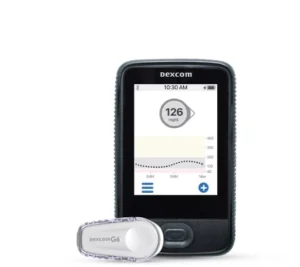
The sensor and transmitter are combined in one compact unit. Wear time is 10 days plus a 12-hour grace period for replacement. Readings go to a smartphone or the Dexcom G7 receiver, with flexible alarm settings. Available as a single sensor or a one-month kit.
It has the same compact all-in-one design as the G7 and the same wear time: 10 days plus 12 hours. It is the Dexcom option for everyday glucose monitoring. See the Dexcom ONE+ sensor and the one-month kit.
The previous generation: a 10-day sensor and a separate transmitter used for about three months. It is still chosen by people who are used to the system or use compatible equipment.
| System | Sensor wear time | Where readings go | Separate transmitter |
|---|---|---|---|
| FreeStyle Libre 2 Plus | up to 15 days | smartphone or reader | no |
| FreeStyle Libre 3 Plus | up to 15 days | smartphone or reader | no |
| Dexcom G7 | 10 days + 12 h | smartphone or receiver | no |
| Dexcom ONE+ | 10 days + 12 h | smartphone or receiver | no |
| Dexcom G6 | 10 days | smartphone or receiver | yes, for about 3 months |
Discuss the final choice with your endocrinologist, especially if your insulin dose depends on the readings.
A CGM removes most finger pricks, but it is worth keeping a meter and test strips at home. You need it when how you feel does not match the sensor reading, when glucose is falling or rising quickly, if the sensor fails or loses signal, and whenever your system’s instructions or your doctor recommend it.
Most people feel no more than a light tap: the applicator inserts the filament in a second. The needle does not stay under the skin, only the flexible filament does.
Yes, modern sensors are water-resistant, but there are limits on depth and time in water. The exact conditions are in the instructions for each model.
Many systems are approved for children aged 2 and over. Check the age limits for a specific model in its instructions and with your doctor.
No. A sensor shows day-to-day changes, while tests such as HbA1c are ordered separately by your doctor.
There are no medical-grade, fully non-invasive glucose meters yet, and “watches that measure sugar” should not be used to manage diabetes. The real alternative to constant finger pricks is a continuous glucose monitoring sensor, which lets you see your glucose around the clock without routine finger pricks. You can choose a system in our FreeStyle Libre and Dexcom sections. If you need help choosing, contact our support team.
Subscribe and get a personal 5% code for Libre, Dexcom and Omnipod supplies. No spam — only useful CGM tips and offers.


